ProDentim Side Effects: What to Know Before You Take It
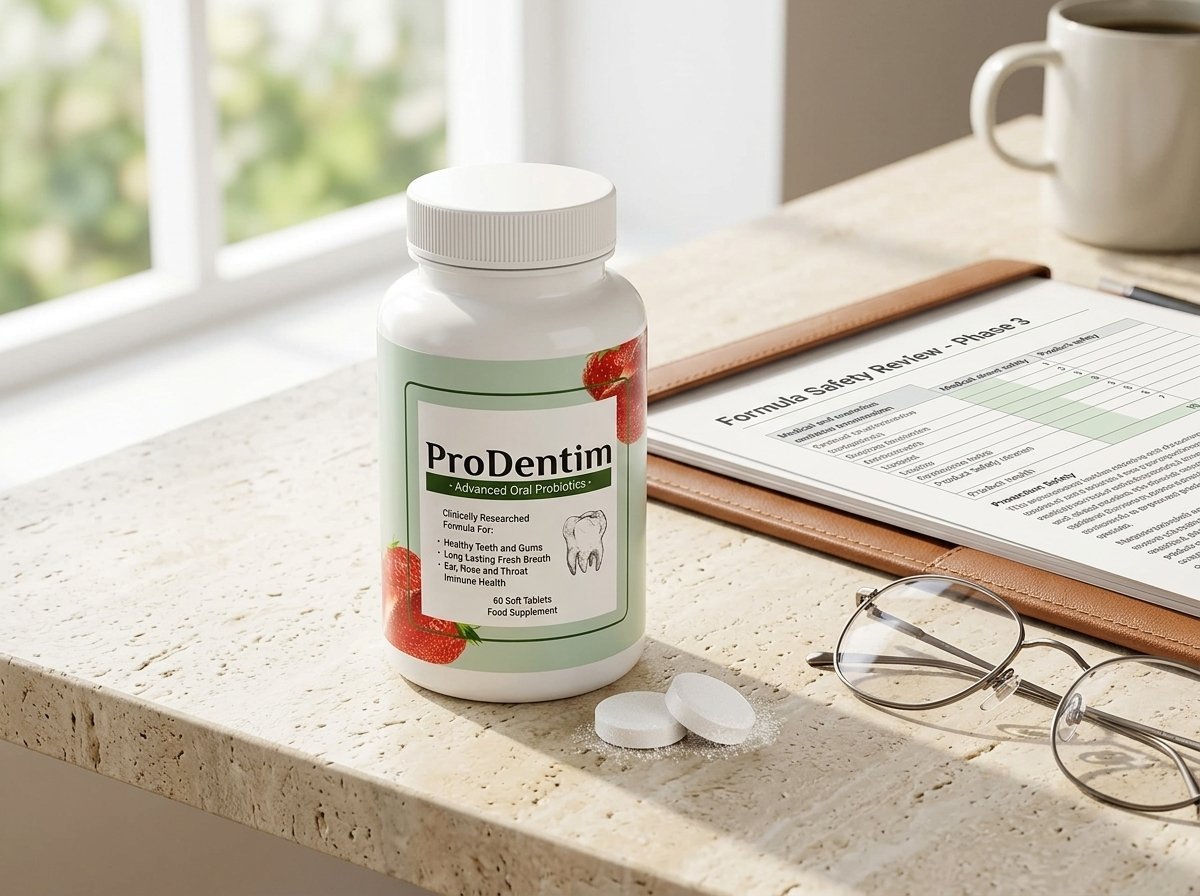
ProDentim is a dissolvable oral probiotic supplement built around three probiotic bacteria, inulin, tricalcium phosphate, malic acid, and peppermint.
For most healthy adults, nothing in the disclosed ingredient list suggests an unusual safety concern. The most plausible mild issues are digestive discomfort from inulin and oral sensitivity in people who already react to mint or menthol.
The more important precautions apply to specific groups: people with significant immune compromise, those taking medications that may interact with calcium, and populations for whom ProDentim-specific safety data is limited.
This article focuses specifically on ProDentim side effects, ingredient sensitivities, medication considerations, and situations where professional guidance makes sense.
For a full formula analysis, see our ProDentim Ingredients article. For pricing, buyer fit, guarantee terms, and the overall purchase decision, see our complete ProDentim review.
Quick Answer
For a generally healthy adult, ProDentim’s disclosed ingredients appear relatively straightforward from a safety perspective.
The most plausible mild side effects include gas, bloating, mild digestive discomfort, and oral irritation in people sensitive to mint or menthol.
These are ingredient-based possibilities, not established ProDentim-specific incidence rates.
More important precautions apply if you are significantly immunocompromised or seriously ill, take prescription medications that may interact with supplemental calcium, have a known sensitivity to mint or menthol, are pregnant or breastfeeding, or are considering ProDentim for a child.
The key point is that ProDentim does not appear unusually concerning for most healthy adults, but the product also does not publish the kind of clinical safety data that would allow us to quantify side-effect rates precisely.
Possible Mild Side Effects
Gas or Bloating
Inulin is the ingredient most likely to explain mild digestive discomfort.
Inulin is a fermentable prebiotic fiber. Gut bacteria metabolize fermentable fibers, and that process can produce gas.
Some people may therefore notice bloating, gas, abdominal fullness, or mild stomach discomfort.
This is especially relevant for people who already know they are sensitive to inulin, fructans, or other fermentable fibers.
The amount of inulin in ProDentim is not disclosed, so we cannot predict how likely digestive symptoms are or how strong they might be.
Health Reviews take: mild digestive discomfort is plausible, but there is no ProDentim-specific evidence showing how often it occurs.
Mint or Menthol Sensitivity
Peppermint is included primarily for flavor and oral freshness.
Most people tolerate mint-flavored oral products without difficulty, but contact sensitivity to peppermint or menthol has been documented in selected patients with recurring intra-oral symptoms.
An important limitation is that this research involved patients who had already been referred for conditions such as burning mouth, recurrent oral ulceration, or lichenoid reactions. It does not tell us how common mint sensitivity is among typical consumers.
For someone who already experiences irritation from mint-flavored toothpaste, mouthwash, gum, or lozenges, however, ProDentim’s peppermint content is worth considering.
Possible signs of sensitivity may include persistent burning, unusual oral irritation, recurring sores, or swelling or discomfort that appears after use.
Health Reviews take: this is mainly relevant to people with an existing history of mint or menthol sensitivity rather than the average user.
Sour or Acidic Sensation
ProDentim contains malic acid.
Malic acid contributes tartness and can stimulate saliva, so a mild sour sensation while the tablet dissolves would not be surprising.
The product does not disclose its malic acid amount or final acidity, so we cannot quantify any enamel-related effect.
For most users, this is not an obvious safety concern.
People with documented enamel erosion or significant acid-related dental wear may simply want to ask their dentist whether regular use of an acidic dissolvable supplement is appropriate for them.
Medication Interaction Considerations

ProDentim contains tricalcium phosphate, a calcium-containing ingredient.
At sufficient doses, calcium supplements can interfere with the absorption of certain prescription medications.
The important limitation here is that ProDentim does not disclose how much tricalcium phosphate or elemental calcium it provides.
That means we should not automatically assume that ProDentim behaves like a conventional calcium supplement.
Still, the presence of calcium is worth flagging for people taking medications with known calcium interactions.
Levothyroxine
Calcium supplements can reduce levothyroxine absorption when taken too close together.
Because the amount of calcium in ProDentim is unknown, people taking levothyroxine should ask their pharmacist or prescriber whether dose separation is necessary.
Certain Antibiotics
Calcium can bind to some tetracycline- and quinolone-family antibiotics and reduce their absorption.
Again, the clinical relevance depends on the calcium amount and timing.
If you are taking one of these antibiotics, a pharmacist can advise whether ProDentim should be separated from the medication or temporarily avoided.
Dolutegravir
Calcium supplements can also affect dolutegravir absorption depending on how the medication and calcium are taken.
Anyone using dolutegravir should ask their pharmacist or prescriber how a calcium-containing supplement fits into their medication schedule.
Lithium
Long-term use of calcium supplements alongside lithium may raise the risk of elevated blood calcium levels. This is a less immediate concern than the absorption interactions above, but worth mentioning to a prescriber if you take lithium regularly.
What About Other Medications?
If you take regular prescription medication, especially a medication known to interact with minerals, it is reasonable to mention ProDentim to your pharmacist.
This is preferable to assuming an interaction exists simply because tricalcium phosphate appears on the label.
Health Reviews take: calcium interactions are real, but the undisclosed amount in ProDentim means the actual relevance must be assessed individually.
Who Should Check With a Healthcare Professional First?
Medical Caution & Pre-Use Guidance:
You should consult a qualified physician, dentist, or pharmacist before taking ProDentim if you:
- Are significantly immunocompromised, undergoing cancer therapy, or critically ill
- Take prescription levothyroxine, dolutegravir, or tetracycline/quinolone antibiotics
- Have documented intra-oral contact allergies to peppermint or menthol
- Are pregnant, planning to become pregnant, or breastfeeding
- Are considering supplement use for infants or young children
In these situations, professional clinical evaluation should precede the introduction of any new dietary or probiotic supplement.

People With Significant Immune Compromise or Serious Illness
Probiotic products are generally well tolerated by healthy adults.
However, the National Center for Complementary and Integrative Health notes that the risk of harmful effects from probiotics is greater in people with severe illness or compromised immune systems.
Rare invasive infections involving Lactobacillus species have also been reported, mainly in medically high-risk populations.
This does not mean probiotics are dangerous for the typical healthy user.
It does mean extra caution is reasonable for people who are significantly immunocompromised, critically or seriously ill, undergoing intensive cancer treatment, recovering from major medical procedures, or managing other conditions that substantially increase infection risk.
For these groups, medical guidance should come before starting ProDentim or any new probiotic.
People With Known Mint or Menthol Sensitivity
If mint-flavored toothpaste, gum, mouthwash, or lozenges regularly cause oral burning or irritation, ProDentim may not be a good fit without first discussing that sensitivity with a dentist or clinician.
People Taking Relevant Prescription Medications
Anyone taking levothyroxine, certain antibiotics, dolutegravir, or other medications affected by calcium should ask a pharmacist whether the undisclosed calcium amount in ProDentim is clinically relevant.
Pregnancy and Breastfeeding
There is no ProDentim-specific clinical safety data for pregnancy or breastfeeding in the material we reviewed.
That does not mean the product is known to be unsafe.
It means there is not enough product-specific information to make a confident general recommendation.
A healthcare professional should be consulted before starting it during pregnancy or while breastfeeding.
Children
The available ProDentim information does not establish a pediatric dosing or safety framework.
For that reason, parents should not treat the adult supplement directions as automatically applicable to children.
Who Is Less Likely to Have a Safety Concern?
A generally healthy adult who is not significantly immunocompromised, is not taking a medication with a relevant mineral interaction, does not have a known mint sensitivity, and tolerates prebiotic fibers well has relatively few obvious concerns based on the disclosed ingredient list.
That does not guarantee zero side effects.
It simply means the ingredient profile does not raise an unusual safety signal for that type of user.
When Should You Stop Taking ProDentim?
Stopping the product and reassessing makes sense if you develop a new symptom that clearly appears after starting it and does not improve.
Examples include persistent mouth burning or irritation, recurring oral sores, significant digestive discomfort, or symptoms that worsen with continued use.
If symptoms are mild, stopping the product is often the simplest way to see whether they resolve.
When Should You Seek Medical Help?
Serious reactions are not what we would expect from the disclosed ingredient list in a typical healthy adult, but some symptoms should always be taken seriously.
Seek urgent medical care for signs of a severe allergic reaction such as difficulty breathing, facial or throat swelling, or rapidly developing widespread hives.
Contact a healthcare professional if you develop persistent or worsening oral irritation, significant gastrointestinal symptoms, concerning symptoms while medically immunocompromised, or unexpected changes in how a prescription medication seems to be working.
These recommendations are not unique to ProDentim; they are general safety principles for supplements and oral products.
How to Reduce the Chance of Problems
Read the Current Label
Formulas can change.
Check the current ingredient list before purchasing, particularly if you have food, flavoring, or supplement sensitivities.
Review Your Medications
If you take prescription drugs with known mineral interactions, ask a pharmacist whether the calcium-containing ingredient in ProDentim matters for your medication.
Pay Attention to Existing Sensitivities
If you already react badly to inulin, fermentable fibers, peppermint, or menthol, ProDentim may be more likely to cause discomfort for you than for the average user.
Do Not Use It to Delay Dental Care
Pain, persistent bleeding, swelling, loose teeth, or other significant oral symptoms need professional evaluation.
A probiotic supplement is not a substitute for treating an active dental problem.
Is ProDentim Safe for Daily Use?
For healthy adults, the disclosed ingredients do not reveal an obvious reason that routine use would be unusually risky.
The important caveat is that ProDentim does not appear to have published product-level clinical safety trials that establish long-term side-effect rates for the finished formula.
So the most accurate conclusion is that the ingredient profile appears generally reasonable, mild digestive or sensitivity-related effects are plausible, higher-risk medical populations need more caution, and exact incidence rates are unknown.
For many healthy buyers, that is a relatively reassuring safety picture.
Final Verdict
ProDentim’s safety profile looks fairly straightforward based on its disclosed ingredients.
For most healthy adults, the most realistic concerns are mild digestive discomfort from inulin or irritation in people who are already sensitive to mint or menthol.
The more important precautions apply to specific groups rather than the average user: people with significant immune compromise or serious illness, people taking medications that can interact with calcium, people with known oral sensitivity to mint or menthol, pregnant or breastfeeding individuals, and children.
The presence of tricalcium phosphate deserves a medication-interaction note, but because ProDentim does not disclose the amount, it would be inappropriate to assume that every calcium-supplement interaction automatically applies at a clinically meaningful level.
Likewise, rare invasive infections linked to probiotic organisms have been reported, but these events are mainly relevant to medically high-risk populations and should not be presented as a typical risk for healthy users.
Bottom line: nothing in ProDentim’s disclosed formula suggests an unusual safety concern for a generally healthy adult. The most sensible approach is to consider your own medication use, immune status, and ingredient sensitivities rather than treating the product as either completely risk-free or inherently dangerous.
If none of the caution categories above apply to you, ProDentim’s ingredient profile is reasonably straightforward from a safety perspective.
For the complete buying decision, including formula quality, evidence, value, and who the product may suit, read our full ProDentim review. To evaluate vendor credibility, refund terms, and customer feedback, see our ProDentim Legitimacy Guide.
Frequently Asked Questions
What are the possible side effects of ProDentim?
The most plausible mild effects are gas, bloating, or digestive discomfort from inulin. People with a known sensitivity to mint or menthol may also experience oral irritation. There is no reliable ProDentim-specific incidence data showing how frequently these reactions occur.
What is the most common ProDentim side effect?
There is not enough product-specific safety data to identify a confirmed “most common” side effect. Based on the ingredient list, mild digestive discomfort from inulin is one of the more plausible reactions.
Can ProDentim cause bloating or gas?
Yes, it is plausible. Inulin is a fermentable prebiotic fiber and can cause gas or bloating in some people, particularly those who are sensitive to fructans or other fermentable fibers.
Can ProDentim cause a mouth reaction?
It is possible in someone sensitive to peppermint or menthol. Published reports of oral contact sensitivity involve selected patients who already had recurring intra-oral symptoms, so those findings should not be interpreted as a general-population side-effect rate.
Does ProDentim interact with medications?
Potentially. ProDentim contains tricalcium phosphate, and calcium can interact with levothyroxine, certain antibiotics, dolutegravir, and some other medications. Because ProDentim does not disclose its calcium amount, ask a pharmacist whether the interaction is relevant to your specific medication.
Is ProDentim safe for people with a weakened immune system?
People with significant immune compromise or serious illness should consult a healthcare professional first. Probiotics are generally well tolerated by healthy adults, but harmful effects and rare invasive infections have been reported more often in medically high-risk populations.
Can ProDentim be taken during pregnancy or breastfeeding?
There is not enough ProDentim-specific safety information to make a general recommendation. Check with a healthcare professional before starting it during pregnancy or breastfeeding.
Is ProDentim safe for children?
The available product information does not establish pediatric safety or dosing. Parents should consult an appropriate healthcare professional rather than applying adult directions to a child.
When should I stop taking ProDentim?
Consider stopping it if you develop persistent digestive discomfort, new mouth irritation, or another symptom that clearly appears after starting the product. Seek urgent medical care for serious allergic symptoms such as difficulty breathing or facial or throat swelling.