ProDentim Ingredients: What’s in the Formula and Does It Make Sense?
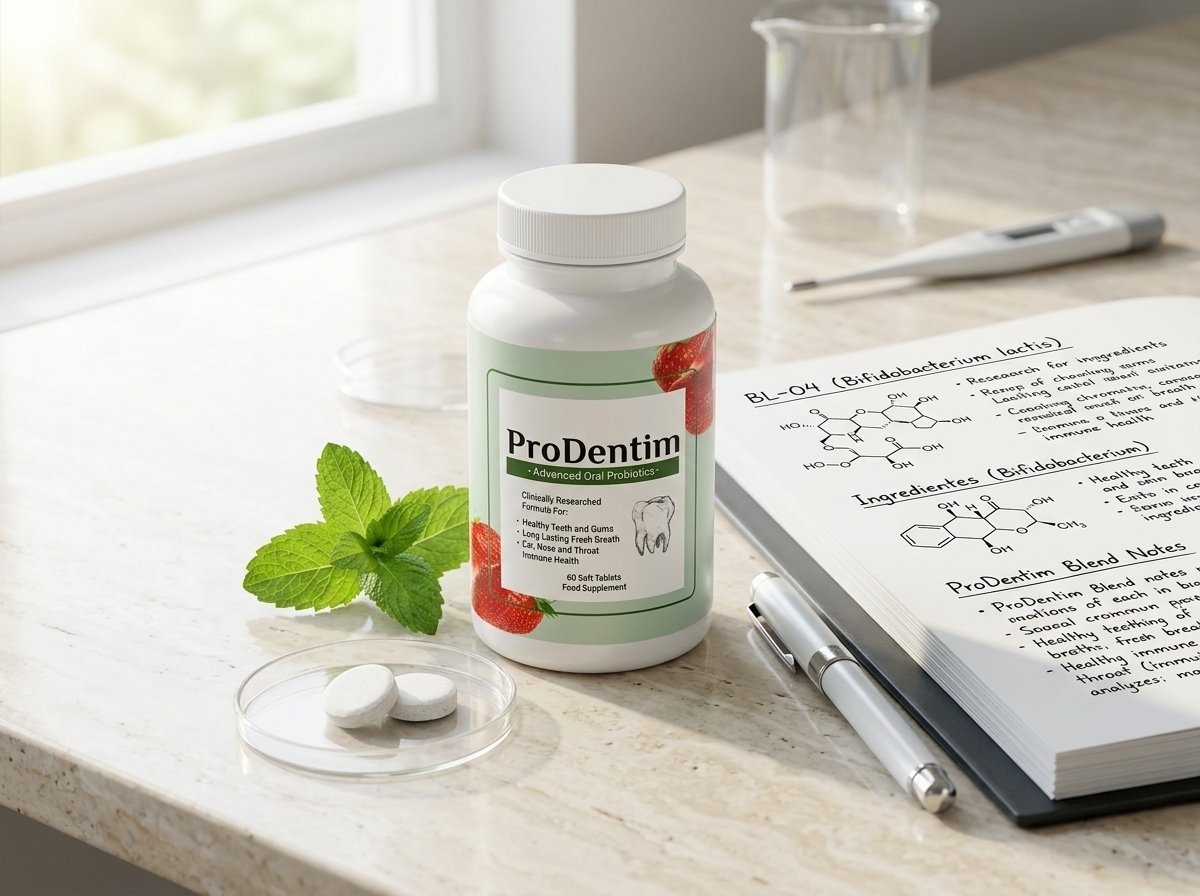
ProDentim combines three probiotic bacteria with inulin, tricalcium phosphate, malic acid, and peppermint in a dissolvable oral supplement.
At a glance, the ingredient list is not random. The probiotic core fits the product’s oral-microbiome positioning, inulin provides a logical prebiotic component, and the remaining ingredients add plausible secondary roles related to mineral support, saliva stimulation, flavor, and oral freshness.
The more important question is how strongly the research behind those ingredients applies to ProDentim itself.
That distinction matters because probiotic evidence is often strain-specific and dose-specific, while research on ingredients such as tricalcium phosphate and malic acid may involve different concentrations or delivery formats.
This article focuses only on the ProDentim ingredients and formula logic. For pricing, guarantee, buyer fit, and the overall purchase decision, see our full ProDentim review.
Quick Answer
Overall, the ProDentim formula makes reasonable sense for an oral probiotic supplement.
Its strongest component is the three-probiotic core, particularly because oral probiotics are a legitimate area of dental research and Lactobacillus reuteri has been studied in human oral-health settings.
Inulin also fits naturally as a prebiotic ingredient.
Tricalcium phosphate, malic acid, and peppermint are better viewed as supporting ingredients rather than the main reasons to buy the product.
The biggest limitation is transparency: ProDentim lists a combined 3.5 billion CFU probiotic count but does not disclose how much comes from each strain or the amounts of its supporting ingredients. That makes it difficult to compare the finished formula directly with doses used in published studies.
For a healthy adult specifically interested in oral microbiome support, nothing in the ingredient list gives us a strong reason to dismiss the formula. The ingredients are reasonably selected; the uncertainty is mainly about how closely the actual formulation matches the conditions used in research.
ProDentim Ingredients at a Glance
| Ingredient | Main Role | Evidence Relevance | Dose Transparency |
|---|---|---|---|
| Lactobacillus paracasei | Oral microbiome support | Human and oral research exists for specific strains | Individual CFU not disclosed |
| Bifidobacterium lactis BL-04 | Probiotic / microbiome support | Related B. lactis strains have periodontal research; BL-04-specific oral evidence is more limited | Individual CFU not disclosed |
| Lactobacillus reuteri | Oral microbiome and gum support | Relevant human oral-health research exists for specific strains | Individual CFU not disclosed |
| Inulin | Prebiotic support | Well-established prebiotic ingredient; ProDentim amount is not disclosed | Amount not disclosed |
| Tricalcium phosphate | Mineral support | Relevant dental research exists mainly in topical formats | Amount not disclosed |
| Malic acid | Flavor and saliva stimulation | Clinical evidence exists in different formulations and populations | Amount not disclosed |
| Peppermint | Flavor and oral freshness | Laboratory antimicrobial research is mixed and concentration-dependent | Amount not disclosed |
The product lists a total of 3.5 billion CFU across its probiotic blend. It does not provide the CFU contribution of each individual probiotic.

The Probiotic Core
The three probiotic ingredients are the most important part of ProDentim.
They define the product’s basic premise: rather than simply targeting unwanted oral bacteria, ProDentim is designed around supporting a more favorable oral microbial environment.
That idea is consistent with a real area of dental research.
The strength of the evidence still varies by species, strain, dose, and study design, so each probiotic deserves to be considered separately.
Lactobacillus paracasei
Lactobacillus paracasei is used in a variety of probiotic products and has been investigated in both gastrointestinal and oral contexts.
Its inclusion in an oral probiotic formula is reasonable because selected L. paracasei strains have been studied for their interactions with oral bacteria and gum-related outcomes.
The main limitation is strain identification.
Probiotic effects cannot always be assumed to apply equally across every strain within the same species. ProDentim identifies L. paracasei at the species level but does not clearly provide the exact sub-strain used.
That means the published research gives the ingredient a plausible oral-health rationale, but it does not allow a precise study-to-product comparison.
Health Reviews take: a sensible probiotic choice for the formula, with the usual strain-specific uncertainty that applies to many commercial probiotic supplements.
Bifidobacterium lactis BL-04
ProDentim is more specific with this ingredient because it identifies the BL-04 strain.
That is a positive transparency point.
Bifidobacterium lactis as a broader probiotic category has been investigated in periodontal research. One notable randomized clinical trial used B. lactis HN019 lozenges as an adjunct to standard periodontal treatment and reported improvements in several clinical measures.
The important detail is that HN019 is not BL-04.
Evidence from one B. lactis strain cannot automatically be transferred to another strain, even when both belong to the same species.
This does not mean BL-04 is a poor inclusion. It means the strongest periodontal evidence available for B. lactis does not directly validate the exact strain used in ProDentim.
BL-04 has also been studied in other probiotic and immune-related contexts, so it is not an unknown commercial ingredient. Its oral-health relevance is simply less directly established than the marketing may imply.
Health Reviews take: a legitimate named probiotic strain and a reasonable component of the blend, but oral claims should not be based on trials of HN019 as if the two strains were interchangeable.
Lactobacillus reuteri
Lactobacillus reuteri is probably the most relevant probiotic ingredient in ProDentim from an oral-health research perspective.
Specific L. reuteri formulations have been tested in human studies involving gingivitis, periodontal bacteria, and periodontal treatment.
One randomized clinical trial found changes in subgingival and salivary microbiological markers after L. reuteri supplementation, although those changes did not translate into a significant clinical improvement during the study period.
Other trials using different L. reuteri strains, doses, or treatment periods have reported clinical benefits in certain periodontal settings.
The overall picture is therefore encouraging but not uniform.
What matters for ProDentim is that L. reuteri is not included merely because it is a fashionable probiotic name. There is genuine oral-health research behind specific strains from this species.
At the same time, ProDentim does not clearly identify the exact L. reuteri strain or its individual CFU amount, so we cannot know how closely the product resembles the formulations used in clinical research.
Health Reviews take: one of the strongest ingredient choices in the formula and a meaningful reason the probiotic blend has a credible oral-health rationale.
Inulin
Inulin is a prebiotic fiber commonly used to support beneficial bacteria.
Pairing a prebiotic with probiotics is a logical formula choice because prebiotics can serve as substrates for selected microorganisms and may support a more favorable microbial environment.
Inulin-type fructans have substantial human research behind their prebiotic effects, particularly in gastrointestinal microbiome studies.
That supports the general logic of including inulin in ProDentim.
The key uncertainty is quantity.
Human studies of inulin-type fructans commonly use defined gram-level intakes. ProDentim does not disclose how much inulin is present in each tablet, so it is not possible to determine whether the amount is comparable to quantities used in those studies.
This does not make the ingredient unnecessary. Its inclusion is still coherent with the probiotic concept. It simply means the magnitude of its functional contribution cannot be judged from the label.
Health Reviews take: a sensible supporting ingredient that strengthens the overall probiotic logic, although the undisclosed amount prevents a more precise assessment.
Tricalcium Phosphate
Tricalcium phosphate is a calcium-and-phosphate compound with obvious relevance to tooth mineral composition.
Calcium and phosphate ions are structural components of enamel, and tricalcium-phosphate-containing dental formulations have been studied in remineralization research.
That gives the ingredient a plausible reason to be included in an oral-health formula.
The important context is delivery format.
Much of the research involving tricalcium phosphate and remineralization uses toothpaste, varnish, or other products designed to contact tooth surfaces directly. ProDentim uses tricalcium phosphate in a dissolvable supplement and does not disclose the amount.
For that reason, the results from topical dental formulations should not be treated as proof that ProDentim provides the same degree of enamel support.
Still, its presence is more logical than simply adding an unrelated mineral for label appeal.
Health Reviews take: a relevant supporting ingredient, but not one we would treat as a major driver of ProDentim’s expected benefits without dose and product-specific evidence.
Malic Acid
Malic acid is naturally present in fruits and is commonly used in foods and supplements for tartness.
It is also known to stimulate saliva.
Human clinical research has tested 1% malic acid sprays in people with xerostomia, including medication-related dry mouth, and has reported improvements in salivary flow and dry-mouth symptoms.
That gives malic acid a real physiological rationale.
However, the studies involved a specific spray concentration, repeated use, and clinical populations with dry mouth.
ProDentim does not disclose its malic acid concentration and is not positioned as a therapeutic xerostomia product.
The most reasonable interpretation is therefore that malic acid contributes to flavor and may provide some saliva-stimulating effect while the tablet dissolves.
Health Reviews take: a logical secondary ingredient with a real mechanism, but the clinical xerostomia literature should not be directly extrapolated to ProDentim.
Peppermint
Peppermint is likely included primarily for flavor and oral freshness.
Peppermint essential oil has also been investigated for antimicrobial and antibiofilm activity against oral organisms such as Streptococcus mutans.
The laboratory literature is not completely consistent. Results vary according to concentration, extraction method, bacterial strain, and experimental conditions.
That makes it difficult to infer a meaningful antibacterial effect from the small, undisclosed amount used in a supplement.
The safer interpretation is that peppermint improves the user experience and may provide a secondary oral-freshness benefit.
Health Reviews take: a useful sensory ingredient with some interesting laboratory research, but not a core reason to expect ProDentim to influence oral bacteria.
Which ProDentim Ingredients Matter Most?
Not all seven ingredients deserve equal weight.
Core Ingredients
The three probiotics are the center of the formula:
- Lactobacillus paracasei
- Bifidobacterium lactis BL-04
- Lactobacillus reuteri
These ingredients determine whether ProDentim’s oral-microbiome positioning is scientifically coherent.
Among them, L. reuteri has some of the most directly relevant human oral-health research.
Supporting Ingredient
Inulin supports the probiotic concept.
It makes sense in the formula even though ProDentim does not disclose enough information to determine whether its amount resembles doses used in human prebiotic studies.
Secondary Ingredients
Tricalcium phosphate, malic acid, and peppermint complete the formula.
They each have a plausible function, but none should be treated as the primary reason to choose ProDentim.
Their main value is that they broaden the formula beyond a basic probiotic blend and support its general oral-wellness positioning.
What Is the Formula Designed to Do?
ProDentim is best understood as a broad oral-wellness formula rather than a narrowly targeted dental product.
The formula appears designed to:
- introduce selected probiotic bacteria;
- support the probiotic concept with a prebiotic;
- add a mineral associated with tooth structure;
- include secondary ingredients related to saliva stimulation, flavor, and freshness.
That structure is coherent.
It also helps explain why the product should not be judged as though it were a toothpaste, fluoride treatment, periodontal therapy, or prescription dental product.
ProDentim is fundamentally a dietary supplement built around oral-microbiome support.
For buyers who understand that positioning, the formula makes more sense than it does when viewed through the marketing language alone.
What Does the Label Not Tell Us?

The main weakness of the ingredient panel is quantitative transparency.
ProDentim provides a combined probiotic total of 3.5 billion CFU but does not disclose the CFU contribution of each individual strain.
The label also does not specify the amounts of:
- inulin;
- tricalcium phosphate;
- malic acid;
- peppermint.
That matters because ingredient research often depends on dose.
It is therefore possible to say that the formula is logically constructed, but not to confirm that each ingredient is present at an amount comparable to published clinical or experimental research.
This is an important limitation, but it should be interpreted correctly.
The problem is not that ProDentim uses obviously inappropriate ingredients. It is that incomplete dose information limits how confidently we can map the product to the research.
One category-common ingredient is also notably absent from the label: xylitol, a sugar alcohol with well-studied effects on reducing Streptococcus mutans levels, appears in a number of competing oral-probiotic and gum-health formulas. Its absence isn’t a flaw on its own, but it’s a useful reference point if you’re comparing ProDentim against other products in the category.
Does the ProDentim Formula Make Sense?
Overall, yes.
The probiotic core is the strongest part of the product.
Each of the three bacteria has a reasonable place in a probiotic formula, and L. reuteri in particular gives ProDentim a genuine connection to human oral-health research.
Inulin complements that approach in a logical way.
The supporting ingredients are less decisive, but tricalcium phosphate, malic acid, and peppermint are not arbitrary additions. Each has a recognizable role related to oral wellness, even though the available research does not directly test the way ProDentim uses them.
The main scientific weakness is therefore not poor ingredient selection.
It is the lack of individual strain CFU counts and supporting-ingredient amounts.
That distinction matters for buyers.
A formula can be reasonable without being clinically proven as a finished product, and that is the most accurate way to describe ProDentim.
Formula Strengths
Several aspects of the ingredient list work in ProDentim’s favor.
The Product Has a Clear Formula Theme
The ingredients are built around oral microbiome support rather than being a long list of unrelated vitamins, herbs, and proprietary compounds.
That makes the product easier to evaluate and gives the formula a coherent purpose.
It Includes Multiple Probiotic Species
Using more than one probiotic species provides a broader microbiome-oriented approach.
That does not automatically make the product more effective, but it fits the concept the product is trying to deliver.
L. reuteri Is a Relevant Choice
Specific L. reuteri strains have been studied directly in oral-health settings.
That makes it more relevant to ProDentim’s positioning than probiotic species with only gastrointestinal research behind them.
The Dissolvable Format Fits the Product Concept
Although the clinical significance of contact time cannot be assumed, a tablet that dissolves in the mouth is at least intuitively aligned with a product intended for the oral environment.
That is a practical advantage over a conventional capsule that is swallowed immediately.
The Supporting Ingredients Are Coherent
Inulin, tricalcium phosphate, malic acid, and peppermint all have understandable roles.
None of them transforms the formula on its own, but together they create a more complete oral-wellness product.
Formula Limitations
The formula also has clear limitations buyers should understand.
Individual Probiotic CFUs Are Not Disclosed
This is the most important limitation.
Probiotic research is often both strain-specific and dose-specific.
A combined 3.5 billion CFU figure does not tell us how much of each bacterium the user actually receives.
Two Probiotic Listings Lack Full Strain Detail
BL-04 is clearly named, but the label does not provide the same level of strain detail for L. paracasei and L. reuteri.
That limits direct comparison with clinical studies.
Supporting-Ingredient Amounts Are Unknown
Without quantities, it is difficult to determine how meaningful the roles of inulin, tricalcium phosphate, and malic acid are beyond formula logic.
Product-Level Evidence Is Limited
Research on individual ingredients does not prove that the finished ProDentim formula produces the same outcomes.
That is common across the supplement category, but it remains an important distinction.
Ingredient-Specific Safety Notes
ProDentim’s ingredient list is generally straightforward, but a few considerations are worth knowing.
Inulin Sensitivity
Inulin can cause bloating, gas, or digestive discomfort in people who are sensitive to fermentable fibers.
This may be more relevant for people with IBS or known FODMAP sensitivity.
Calcium and Thyroid Medication
Calcium can reduce levothyroxine absorption when the two are taken too close together.
Because ProDentim contains tricalcium phosphate but does not disclose its amount, people taking thyroid medication should ask their pharmacist or prescriber whether spacing the products is appropriate.
Probiotics in High-Risk Individuals
Probiotic supplements are generally well tolerated by healthy adults, but additional caution is appropriate for people who are severely ill or significantly immunocompromised.
Those individuals should seek medical guidance before starting a probiotic supplement.
For pregnancy, breastfeeding, children, medication interactions, and a more complete risk assessment, see our dedicated ProDentim Side Effects article.
Final Verdict on ProDentim Ingredients
ProDentim’s ingredient list is one of the stronger aspects of the product.
The formula has a clear internal logic: probiotics form the core, inulin supports the microbiome concept, and the remaining ingredients provide secondary oral-wellness functions.
The strongest scientific argument is not that every ingredient has been proven to work exactly as used in ProDentim.
It is that the formula is built from ingredients that have legitimate biological or dental relevance rather than from an arbitrary collection of marketing-friendly compounds.
The probiotic component deserves the most weight, particularly L. reuteri.
The main limitation is transparency. Without individual strain CFUs and supporting-ingredient amounts, we cannot know how closely ProDentim resembles formulations used in published research.
For a healthy adult already interested in oral probiotics, that limitation does not automatically make the formula a poor choice. It simply means expectations should remain realistic.
If you’re on thyroid medication, immunocompromised, or otherwise fall into one of the groups noted in the Safety Notes above, treat the ingredient-specific interactions there as your starting point for a conversation with your prescriber or dentist before adding ProDentim — the formula logic being reasonable doesn’t change what those specific interactions require.
Bottom line: ProDentim has a coherent and reasonably well-selected ingredient profile. The probiotic core makes sense, the supporting ingredients are relevant, and nothing in the label gives us a strong reason to dismiss the formula. The biggest unanswered question is not what is in ProDentim, but how much of each ingredient the user is actually getting.
For the full purchase decision — including pricing, guarantee, buyer fit, and whether the product is worth considering overall — read our complete ProDentim review. You can also check our ProDentim legitimacy and seller verification guide.
Frequently Asked Questions
What are the main ingredients in ProDentim?
The formula contains three probiotics — Lactobacillus paracasei, Bifidobacterium lactis BL-04, and Lactobacillus reuteri — along with inulin, tricalcium phosphate, malic acid, and peppermint.
How many probiotics are in ProDentim?
The label lists a combined total of 3.5 billion CFU across three probiotic ingredients. It does not disclose how much of the total comes from each individual probiotic.
Which ProDentim ingredient has the strongest oral-health research?
Lactobacillus reuteri is one of the most relevant ingredients because specific L. reuteri strains have been studied in human gingivitis and periodontal research. The exact strain used by ProDentim is not clearly disclosed, so those studies should be viewed as supporting the ingredient rationale rather than proving the product itself.
Is Bifidobacterium lactis BL-04 clinically studied for periodontal health?
B. lactis has human periodontal research behind it, but an important trial used the HN019 strain rather than BL-04. Because probiotic effects can be strain-specific, the HN019 results should not automatically be attributed to BL-04.
Why does ProDentim contain inulin?
Inulin is a prebiotic fiber. Its inclusion makes sense because prebiotics can support beneficial microorganisms and complement a probiotic formula. ProDentim does not disclose the amount of inulin, so we cannot determine how closely the dose compares with human prebiotic studies.
Does tricalcium phosphate help teeth?
Tricalcium phosphate has been studied in dental remineralization formulations because it provides calcium and phosphate. Most relevant research involves topical products such as toothpaste or varnish, so those results do not directly establish the effect of the amount used in ProDentim.
Why is malic acid in ProDentim?
Malic acid contributes tart flavor and can stimulate saliva. Clinical studies have used malic acid sprays to increase salivary flow in people with dry mouth, although those formulations differ considerably from ProDentim.
Is peppermint an active ingredient in ProDentim?
Peppermint appears to be primarily a flavoring and oral-freshness ingredient. Laboratory research has examined peppermint oil for antimicrobial effects, but the findings are concentration-dependent and do not establish a significant antibacterial effect from the amount used in ProDentim.
Does ProDentim disclose every ingredient dose?
No. The product provides a combined 3.5 billion CFU probiotic count but does not list individual strain CFUs or the amounts of the supporting ingredients.
Is the ProDentim formula good?
The formula is reasonably well designed for its intended positioning. Its probiotic core is relevant to oral-microbiome research, inulin complements that approach, and the remaining ingredients have plausible supporting roles. Its main weakness is incomplete dose and strain transparency rather than poor ingredient selection.